
NEON flightlines · drone imagery · bulk analysis
Three pipelines.Traceable evidence.
Process reflectance and inspect cross-sensor relationships at each scale.
The NEON pipeline corrects and spectrally convolves individual flightlines. The drone pipeline corrects local imagery and can apply reviewed, wavelength-aware affine coefficients without convolution. The independent bulk pipeline studies completed flightlines together and reports coefficient stability and transferability. Each keeps its own outputs and QA trail.
Drone → NEON → Landsat
Why it exists
Three workflows. One inspectable evidence chain.
Use NEON processing for individual hyperspectral flightlines, drone processing for local MicaSense imagery, and bulk analysis for population-level comparisons across completed runs. Synthetic matched-product relationships are diagnostic candidates, not universal empirical calibration.
The system at a glance
Three technical views. Read them one at a time.
The original scientific figure is separated into enlarged panels here. The plots, wavelength ranges, processing stages, and translation relationships remain unchanged; the surrounding text provides a readable path through them.
Measure at three scales.
NEON airborne imaging spectroscopy, MicaSense UAS observations, and Landsat Collection 2 NBAR each sample reflectance differently. The first panel keeps their spectral ranges and sampling patterns visible together.
Why cross-sensor calibration matters →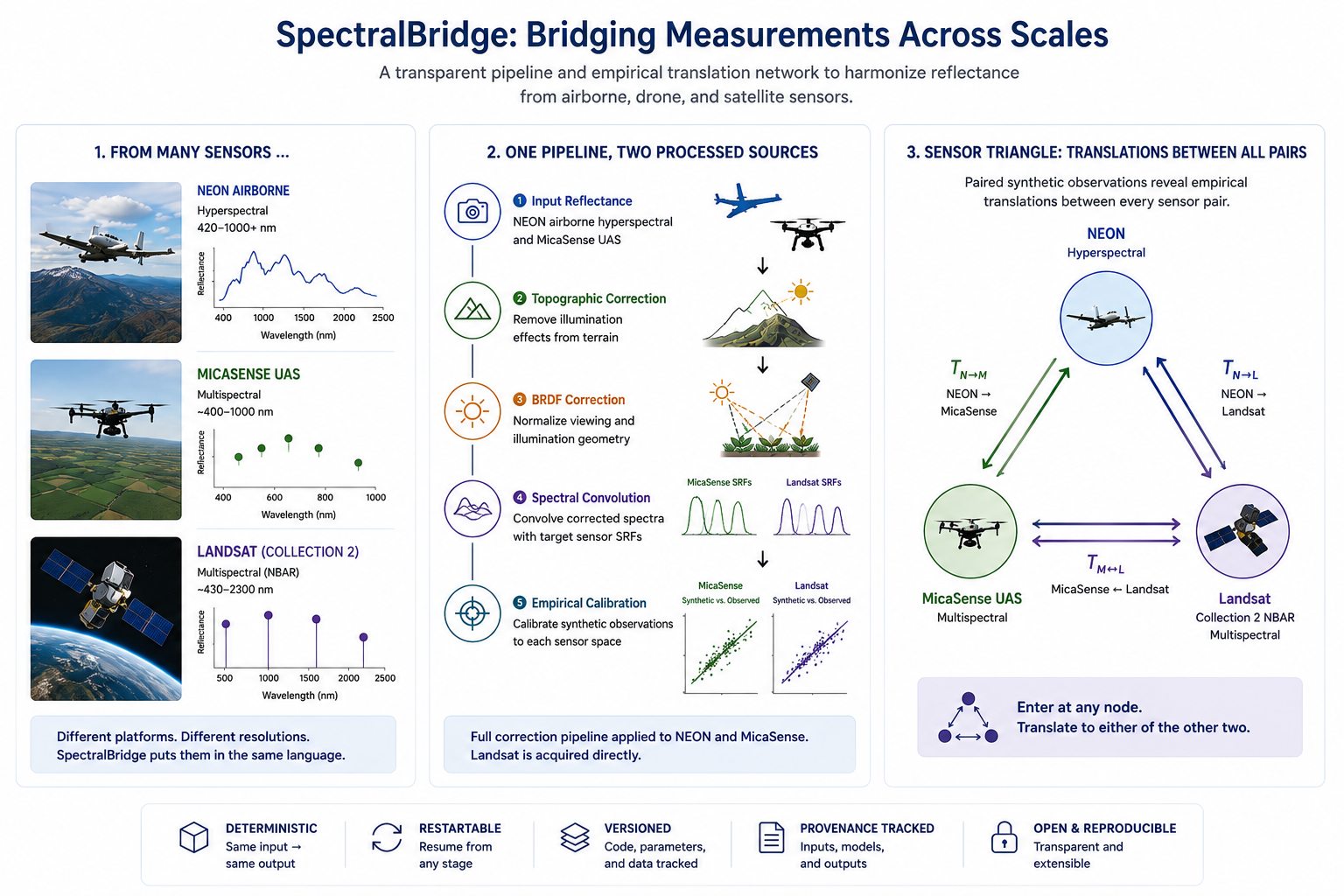
Correct before you compare.
The supplied processing diagram is a conceptual view. In the current package, NEON hyperspectral products use spectral convolution, while drone products use optional post-correction affine translation. Bulk analysis estimates and reviews the relationships from completed products.
Walk through the full pipeline →Use NEON as the hyperspectral anchor.
Matched MicaSense and Landsat products generated from the same corrected NEON source support diagnostic regressions. Actual Landsat comparison is a separate, optional validation step; a strong synthetic fit alone does not prove sensor interchangeability.
Inspect sensor harmonization →- DeterministicSame input, same output
- RestartableResume from any stage
- VersionedCode, parameters, and data tracked
- Provenance trackedInputs, models, and outputs
- Open and reproducibleTransparent and extensible
Choose your way in
Choose the pipeline for your inputs.
NEON flightlines
Correct hyperspectral data, convolve to target sensors, extract tables, and inspect QA.
Run the NEON vignette → 02Drone imagery
Process local TIFF/HDF5, retain corrected native MicaSense, and optionally translate.
Run the drone vignette → 03Bulk analysis
Analyze a curated tree of completed flightlines with compact fits, LOSO, and reporting.
Run the bulk vignette →The NEON processing path
Raw signal in. Traceable products out.
The five steps below describe the individual-flightline NEON workflow. Drone and bulk follow their own linked vignettes above.
Evidence, not mystery
Every transformation should leave a trail.
Validation campaigns record input variation, expected behavior, observed diagnostics, runtime, provenance, and failures. QA panels turn those records into something scientists can inspect.
See how SpectralBridge is validated →Already halfway there?
Carry on from the files you have.
Individual-flightline processing validates existing artifacts and resumes at the first missing or invalid stage.
Carry On My Wayward Son →Ready when you are