From spectra to ecological inference
Difference → identity → quantity → uniqueness → field validation. Each arrow requires additional evidence. A spectral difference can be real while an unseen observation is difficult to recognize. Useful predictions of synthetic fractions can coexist with alternative compositions that fit almost equally well.
The current groups are the recorded researcher cover_category labels:
Deciduous, Evergreen, Herbaceous, Non-vegetated & dead, and Woody shrub.
The background/dead category is a recorded comparator, not a biological plant
functional type. Species-derived historical groupings are not the primary results.
What was tested, and what was found?
| Question | Current evidence | What remains unestablished |
|---|---|---|
| Difference | All 10 category pairs differ in the 4 acquisition-matched cohorts (40 supported contrasts) | Universal differences across regions, correct physical units or causal mechanisms |
| Identity | Full-NEON mean balanced accuracy: 85.2% unseen polygons, 73.8% held sites | Dependable recognition in arbitrary regions/years; Woody shrub is particularly difficult |
| Information retention | Synthetic OLI recognition is 66.8% / 57.7% under the same two evaluation types | Independent actual Landsat performance or calibration |
| Quantity | Ridge120 synthetic fraction RMSE: 0.216 / 0.269 for new parents / held sites | Field fractional cover; intrinsic superiority over MESMA |
| Uniqueness | Alternative evaluated candidate fractions can fit nearly equally well | Exhaustive physical uncertainty or a unique biological inverse |
| Field validation | Independent contemporaneous fractional-cover truth is missing | Operational field abundance accuracy |
Scores are conditional mean-fold summaries, not deployment guarantees or confidence intervals. The library was extensively explored before this structured reanalysis; it is not an independently preregistered confirmation.
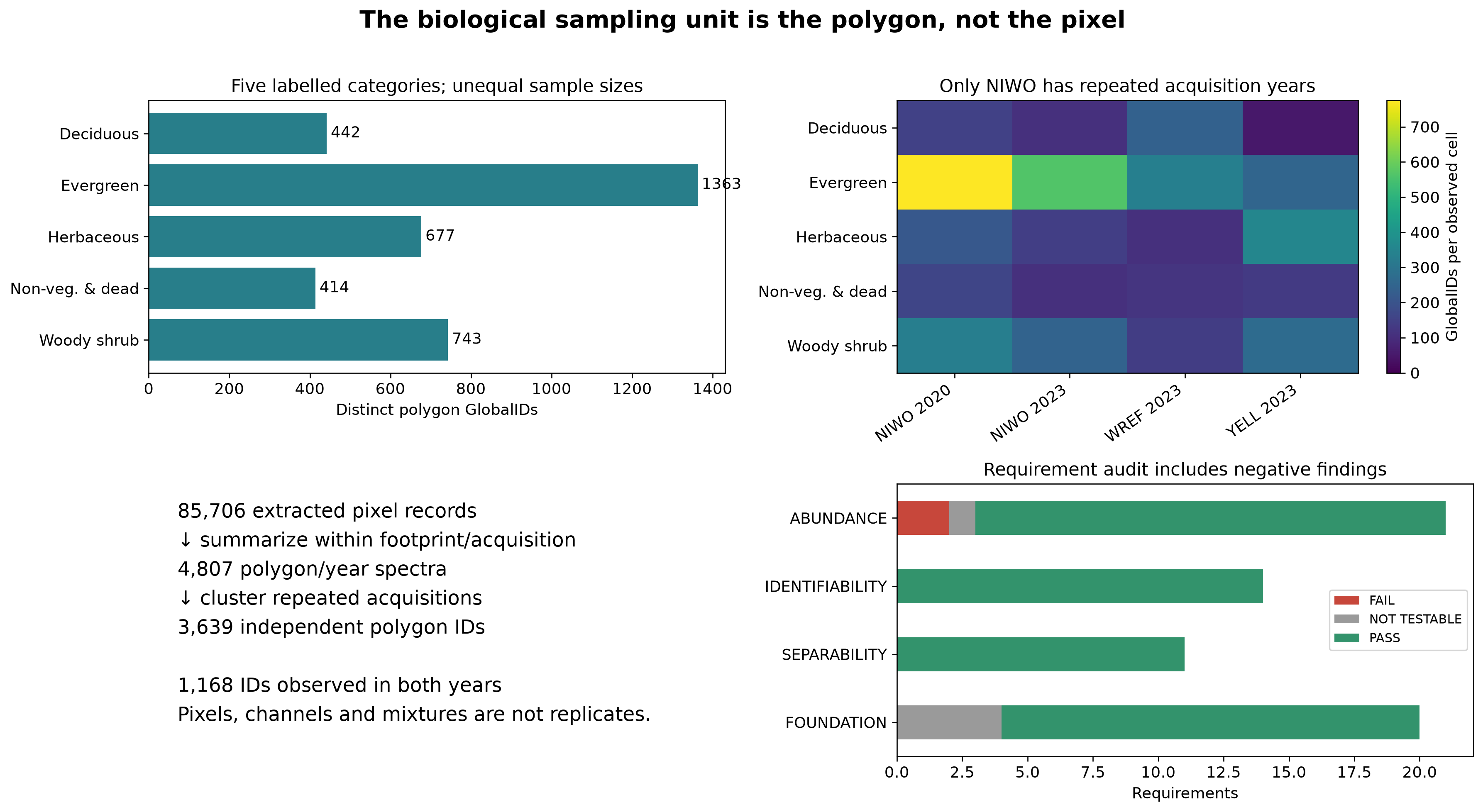
What you see: category support, spectra and the study's validity gates. What to notice: the sampling unit is an independent polygon identity, with repeated acquisitions and only four site/year cells. What it means: the library supports controlled comparisons with explicit domain limits. What it does not mean: pixels, repeated years or generated mixtures are new independent biological samples; category labels do not certify material purity.
The abundance fairness result changes the interpretation
The larger Ridge120 model improves expected synthetic fraction error relative to the 15-candidate MESMA configuration. Restrict ridge to the same 15 retained parents, and the original NEON advantage disappears: new-parent RMSE becomes 0.365 versus MESMA 0.359; held-site RMSE becomes 0.387 versus 0.362. This does not establish that ridge is intrinsically superior to MESMA. Library representation and retained spectral diversity matter. Capacity, training bundles and priors change together, so the control does not isolate a single causal mechanism. Global-year ridge also fails the no-spectrum prior on average.
What exhaustive endmember searching adds
The supplied 603-member synthetic OLI reference library was searched over all 16,918,447 permitted one-to-three-category combinations for each of 360 fixed synthetic targets. Mean spectral RMSE fell from 0.003721 to 0.000792, while pooled PFT fraction RMSE changed from 0.3215 to 0.3336. Fraction error improved for 156 targets and worsened for 203, with one effectively unchanged. The paired eight-bundle uncertainty range includes no aggregate difference.
Better spectral reconstruction does not guarantee better compositional recovery. Candidate screening does not explain away this benchmark result; it is not a universal MESMA failure or proof that all physical inversions are impossible. Selection used the whole library, so this remains an internal synthetic test, not field-cover validation. See the experiment and numerical checks and versioned report.
What the mathematics adds
Fixed linear and appropriate affine transformations preserve an ideal mixture equation. They can still lose information needed to recover its weights. A unique fitted ridge prediction is not a unique physical inverse. A valid simplex fraction vector is not evidence of correct biology. Formal proofs clarify hypotheses; numerical checks and independent observations test whether the implementation and world meet them.
Run these methods on your own library
From a source checkout, install the analytics extra for the generic numerical API:
python -m pip install -e '.[analytics]'
These functions are part of this checkout; a containing PyPI release has not been verified. Start with the API contracts and offline teaching example. The example connects separability, recognition, feature budgets, paired representations, mixtures, FCLS/MESMA/ridge, ambiguity, errors and library capacity using invented data. Numerical API stability is distinct from ecological validity.
Evidence and next observations
The canonical evidence packet contains the claim registry, random/PCA controls, matched15 comparison, source identities and adversarial checks. Its numerical companion contains the primary recognition scores and synthetic benchmark. Figure source hashes identify the reused artwork. Collect independent aligned field fractions, verify units and purity, add sites crossed with years, and reannotate repeated observations contemporaneously. More mixtures from the same parents cannot supply those observations.