Where do researcher categories differ, and can those differences predict?
The current three-question validation adds matched random/temporal recognition and same-candidate abundance controls. The latter removes the larger-library NEON ridge advantage when reduced to the exact 15 MESMA parents. Treat the preceding numerical snapshot below as a preserved companion, with this new capacity limitation.
The sole primary grouping is the five recorded researcher categories. Statistical difference, recognition and fractional abundance are separate tasks.
Whole-spectrum and individual-wavelength evidence
Existing exact-acquisition-history tests compare whole polygon/year curves within site/year cohorts. Labels move as synchronized curves inside eligible mixed blocks, preserving wavelength covariance. Maximum and integrated evidence combine into an NPC test; Holm controls the declared pair/cohort family. All forty supported researcher-category comparisons are retained as evidence, with varying effect magnitudes rather than forty identical biological effects.
The new atlas derives wavelength-wise evidence from the saved null maxima: maximum-statistic correction across coordinates, then Bonferroni across forty pair/cohort contrasts. These full-cohort descriptive tests are not used to select features for predictive tests. Atmospheric gaps remain disconnected. A statistically supported coordinate may still predict individual polygons poorly.
Single-wavelength discrimination and transfer
A prespecified balanced-prior univariate discriminant learns its direction and threshold from training identities only. It measures held-out balanced accuracy, AUC, sensitivity and specificity for every category pair and usable coordinate. It is a particular predictive rule, not an upper bound on all information in a channel. Site/year values, sign consistency, rank dependence and the weakest observed-site score stay visible rather than disappearing into one average.
Complementary spectral measurements
An orthogonal residual selector searches for complementary label information. Every inner group fold refits selection; inner balanced accuracy chooses logistic regularization. Outer new-polygon and entire-site tests remain untouched. Budgets are 1,2,3,5,7,10,20,50,100 and all supported coordinates, plus synthetic OLI. Independent top-coordinate ranking is not called an optimal sensor design.
| Primary question | New polygon parents / identities | Held site |
|---|---|---|
| Full NEON five-category balanced accuracy | 85.2% | 73.8% |
| Synthetic OLI five-category balanced accuracy | 66.8% | 57.7% |
| Synthetic NEON fraction RMSE: MESMA | 0.359 | 0.362 |
| Synthetic NEON fraction RMSE: projected ridge | 0.216 | 0.269 |
Only recorded researcher cover categories define the current biological groups. Scores are conditional on sampled source labels and domains. Synthetic fractions are known algebraic weights, not independent field cover. Better regression does not establish unique physical inversion or operational abundance validity.
Versioned atlas, numerical products and methodology contains class recall/precision/specificity, full confusion matrices and explicit year-transfer support. Complete NIWO paired histories are held out together; reused later annotations remain a temporal-interpretation limitation.
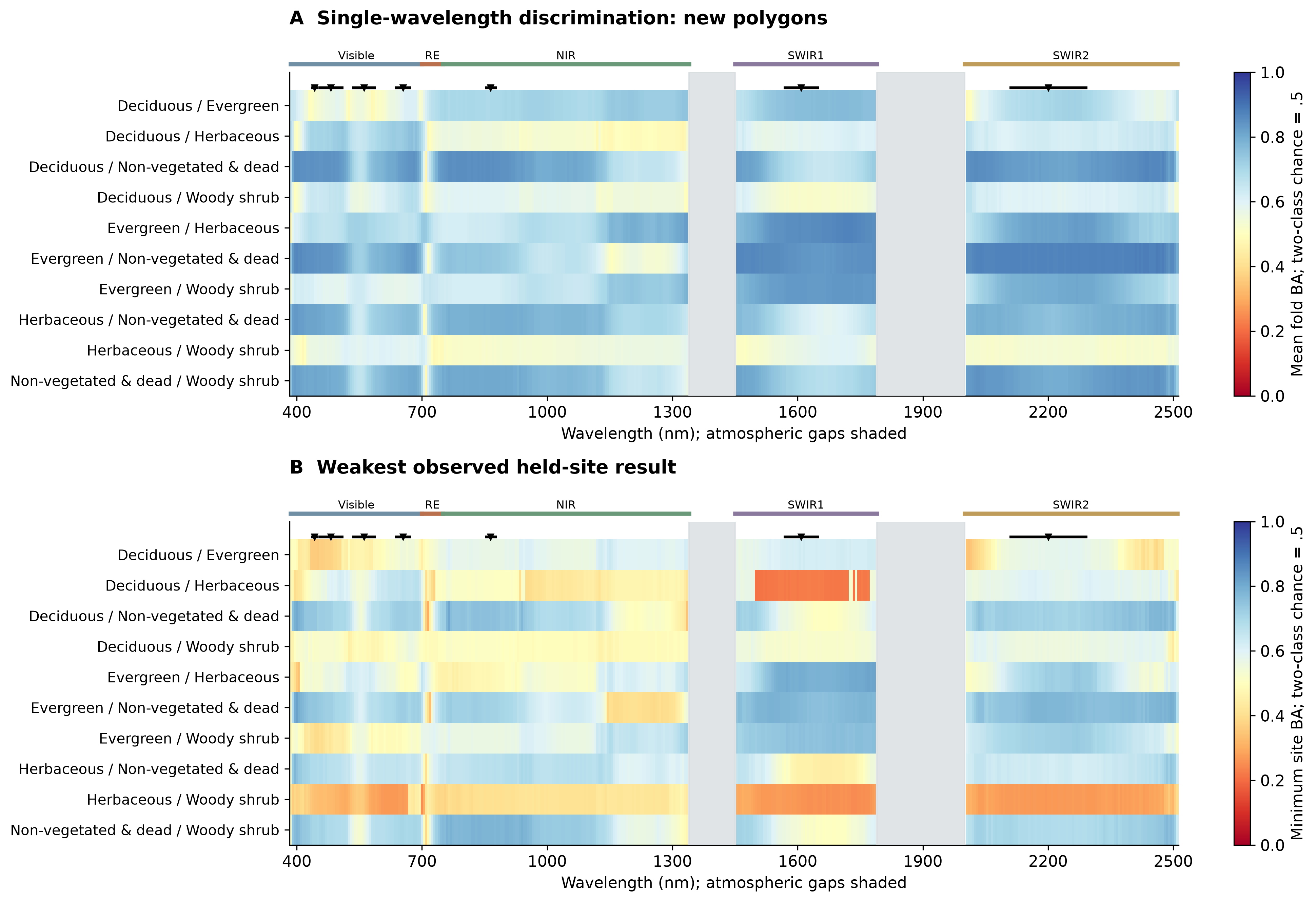
The same prespecified single-wavelength rule can recognize sampled identities and fail at an entire held-out site. The map is predictive performance, not a p-value or a claim about every possible nonlinear rule.