Separability: where do labelled spectra differ?
Scientific result
All ten researcher-category pairs show whole-spectrum differences in the observed acquisition-matched cohorts. Four supported cohorts give forty pair/cohort contrasts; the largest adjusted whole-spectrum p-value is 0.004 in the canonical pair-support table. Labels move as whole curves within eligible exact-acquisition-history blocks. Conditional exchangeability is required; nearby distinct polygons can still be correlated.
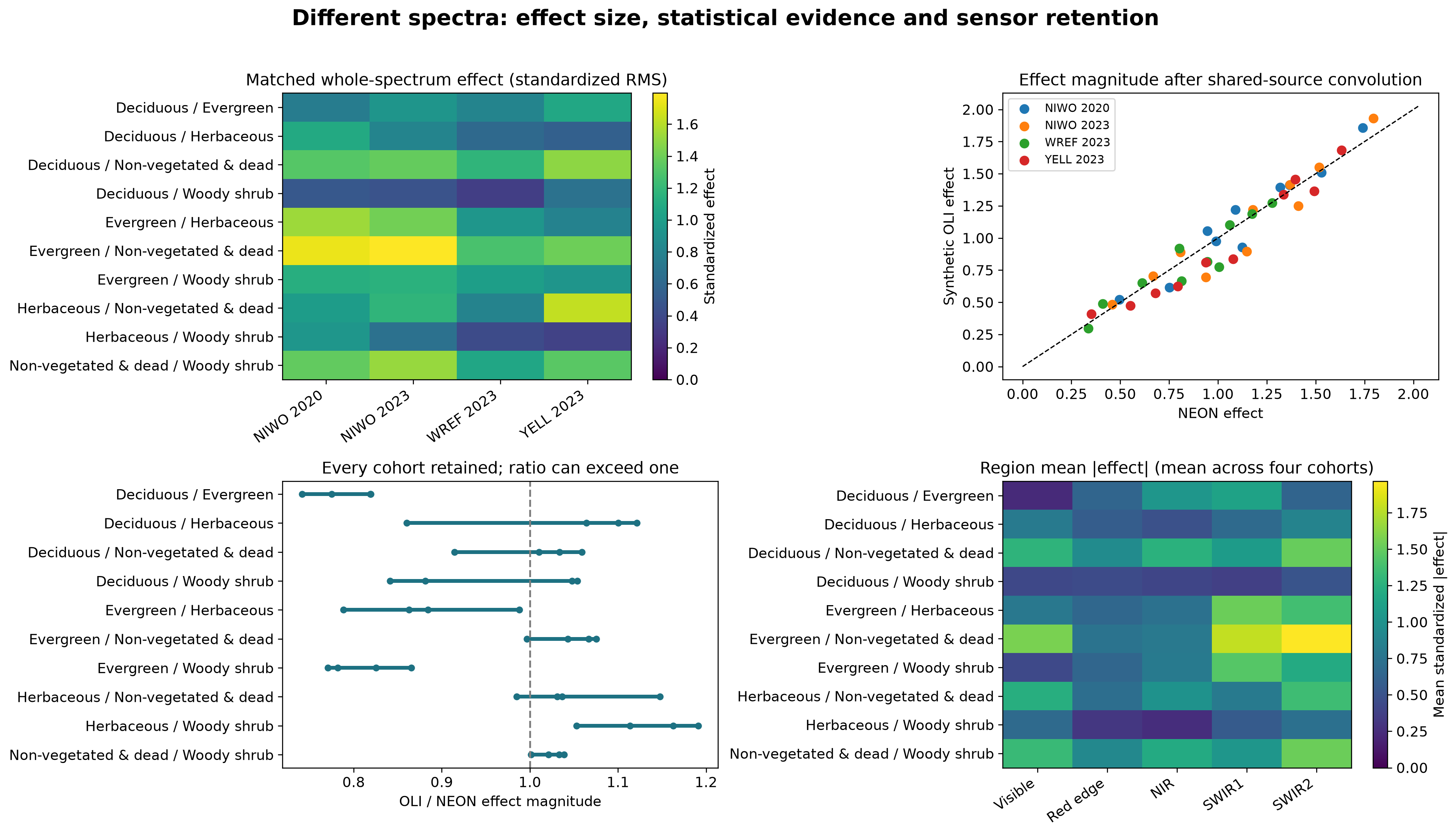
What you see: pairwise standardized spectral differences and sensor retention. What to notice: strength and retention vary among pairs and domains. What it means: all pairs differ in these matched sampled cohorts. What it does not mean: significance measures recognition accuracy, purity or abundance. An OLI standardized effect ratio above one can reflect reduced within-class variation.
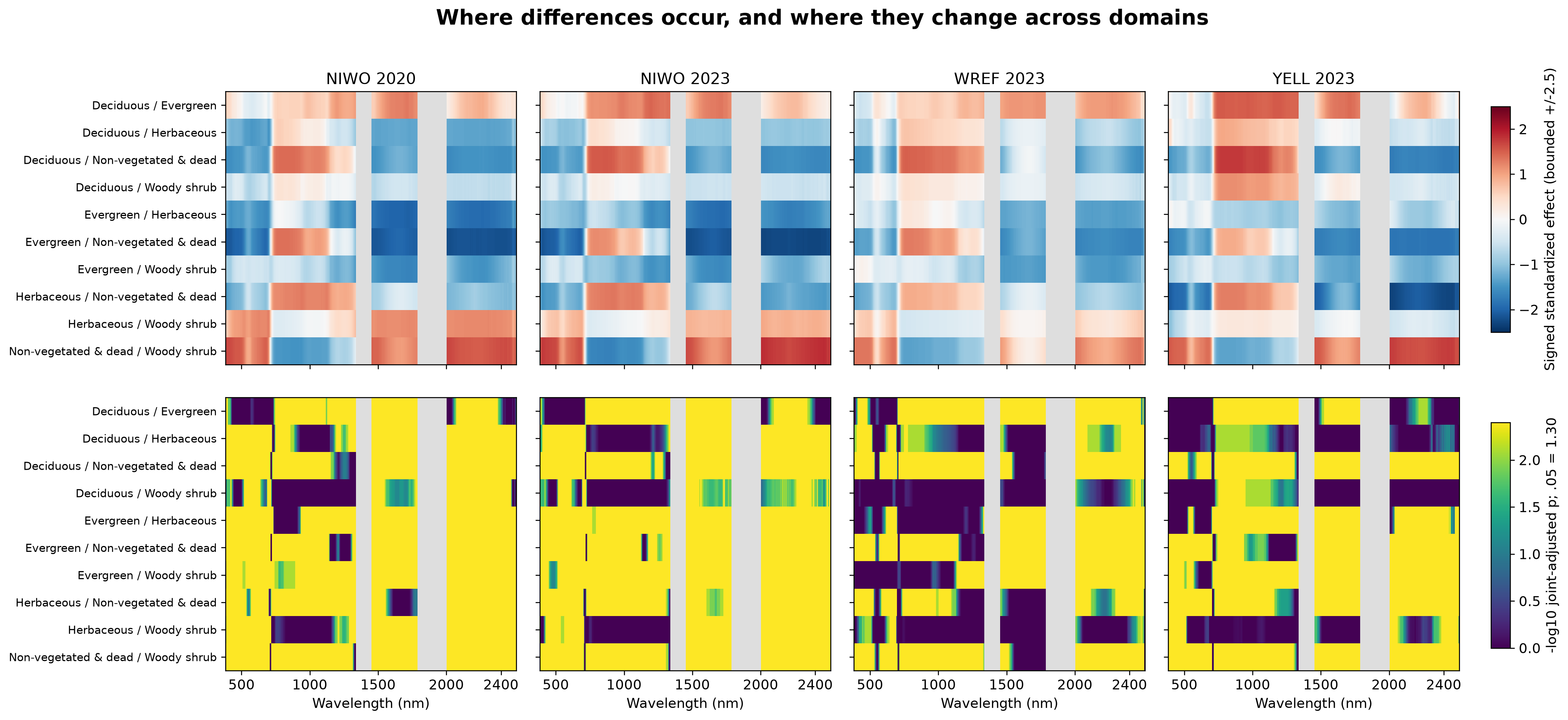
What you see: signed effects above and adjusted evidence below, with masked gaps. What to notice: broad regions carry evidence, but direction and magnitude vary. The figure's signed effect is the displayed first category minus the second; the generic API explicitly uses second minus first. What it means: spectral covariance and domain context matter when interpreting coordinates. What it does not mean: adjacent channels are independent confirmations, the map is a confidence interval, or descriptive full-cohort effects can select predictive features using held-out targets.
Run this analysis with SpectralBridge
import numpy as np
from spectralbridge.library_analysis import spectral_separability
rng = np.random.default_rng(2)
labels = np.repeat(['group A', 'group B'], 20)
spectra = rng.normal(size=(40, 6)) + (labels == 'group B')[:, None]
result = spectral_separability(
    spectra, labels, np.arange(500., 506.), groups=np.arange(40),
    permutations=99, regions={'visible example': (500, 505)},
)
print(result['pairs'][['first', 'second', 'p_max_holm', 'p_npc_holm']])
Supply true independent identities, not pixel-row IDs. Repeated identity curves
are averaged only when labels and exchangeability blocks are constant. Use
blocks= for the justified randomization strata. Strictly increasing wavelengths,
common units and a boolean support mask= are required; explicitly mask atmospheric
gaps for real spectra. Default missing-value behavior rejects nonfinite supported
values; missing='drop_columns' removes incomplete columns before aggregation.
The API reuses the audited binary statistic kernel. Permutations are synchronized across wavelengths within each pair. Coordinate maxima control that pair's spectral family; Bonferroni then controls the declared pairs. Whole-spectrum max, integrated, energy, FPCA and combined NPC p-values receive Holm correction across pairs separately for each method. This generic call does not automatically recreate the study's forty-contrast cohort family: callers running additional cohorts must declare and adjust that larger family. Region summaries are descriptive integrated effects, not additional unadjusted significance tests.