What researcher-category information survives synthetic Landsat reduction?
The paired synthetic experiment uses corrected NEON and seven undarkened OLI channels on identical polygon/year support. The five recorded researcher categories are the only primary biological groups.
All forty researcher-category whole-spectrum contrasts retain combined-test support in synthetic OLI. This does not mean all magnitudes or prediction scores are preserved: significance, effect size and held-out recognition are different quantities. The new information atlas maps individual-channel discrimination, configured OLI response regions and nested full-spectrum-versus-OLI prediction.
Synthetic OLI changes spectral response at native/polygon support. It is not an independent satellite observation and does not spatially aggregate a sparse polygon sample into a 30 m satellite footprint. FWHM annotations indicate the configured response interval; Gaussian tails extend beyond that interval.
The source brightness adjustment applies fixed positive bandwise gains. Standardized contrasts are scale-invariant, so their stability under this adjustment does not validate absolute radiometry. A separate real-Landsat pilot compares one independent next-day R10C acquisition pair at matched 30 m support. Its scope remains one flight/scene, not regional calibration.
MicaSense physical band identities remain unresolved. No guessed wavelengths, physical transfer result or independent drone-validation claim is included.
Canonical researcher-category analysis provides paired NEON/OLI class-specific recognition and synthetic-fraction results.
Current recognition result and mathematical interpretation
Full NEON → configured sensor representation → synthetic OLI asks how much information survives. Mean balanced accuracy falls from 85.2% to 66.8% for unseen polygons and from 73.8% to 57.7% for held sites in the primary recognition table. All forty observed researcher-category combined-test contrasts retain support; significance and recognition performance are different quantities.
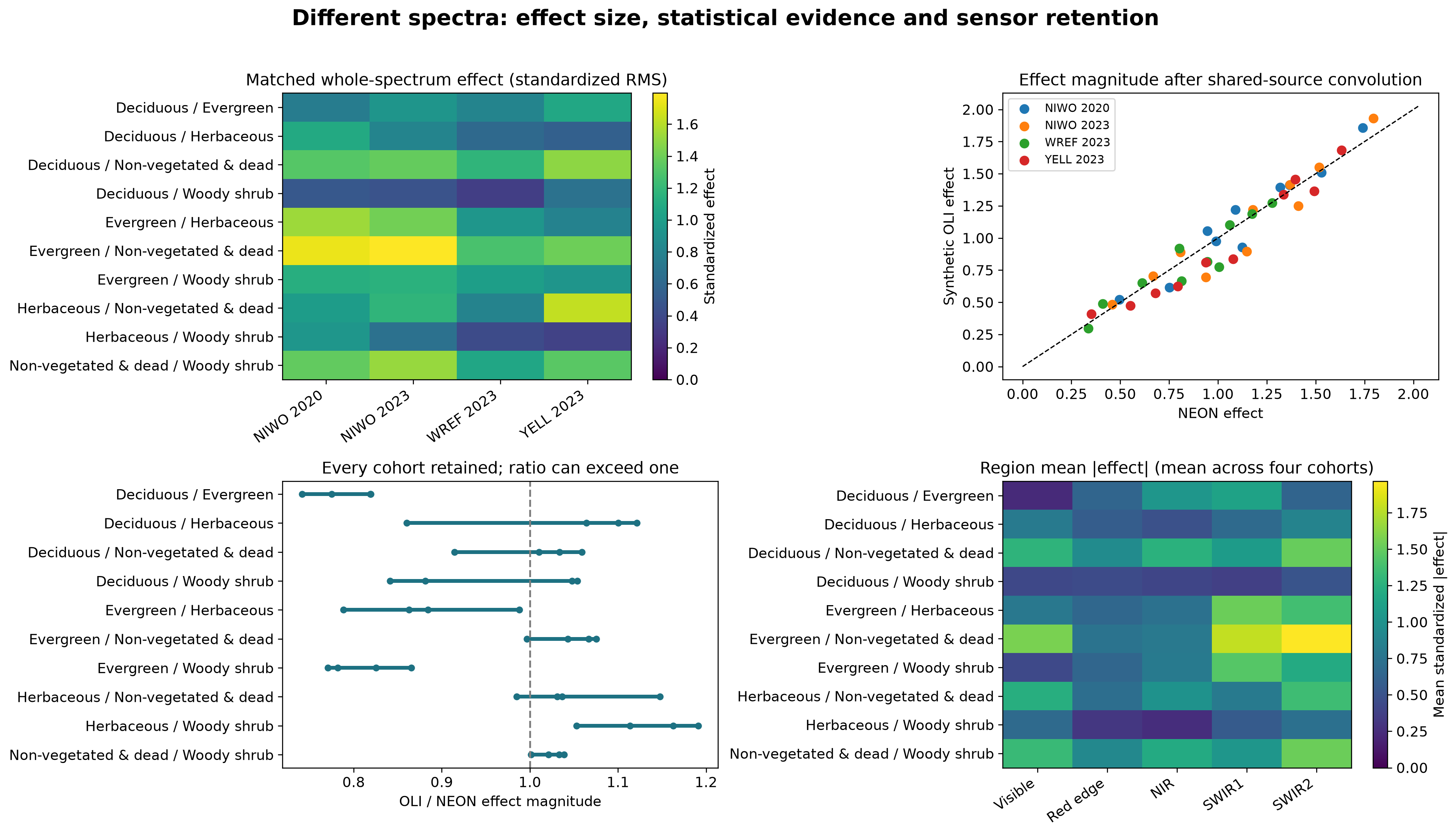
What you see: paired NEON/synthetic OLI effect comparisons. What to notice: retention varies by category pair/domain; standardized ratios can exceed one when within-class variability is smoothed. What it means: some group information survives response reduction, with losses in predictive performance. What it does not mean: synthetic OLI is equivalent to a real Landsat acquisition or validates cross-platform physical calibration.
The formal result explains a compatible mechanism: a fixed transformation can preserve the ideal mixture equation while collapsing information needed to distinguish compositions. It does not prove that this mechanism alone causes the observed accuracy gap.
Run this analysis with SpectralBridge
import numpy as np
from spectralbridge.library_analysis import compare_representations
rng = np.random.default_rng(4)
y = np.repeat(['A', 'B'], 18)
x = rng.normal(size=(36, 6)) + (y == 'B')[:, None]
result = compare_representations(
    {'original': x, 'two_coordinate_view': x[:, :2]}, y, np.arange(36),
    folds=3, inner_folds=2,
)
print(result['summary'])
Representations must have exactly the same row order and identity lineage.
The method compares classifiers with identical outer/inner split rules and
independent training-only preprocessing. Supply domains= for paired held-domain
scores and transfer penalties; results include dimensions, recall, confusion and
reference differences. It does not manufacture independently measured sensor data.